|
Video
& Audio Cassettes Vcd's
and Dvd's

|
| |
Idea
of Islamic dinar gaining momentum
ArabNews.com
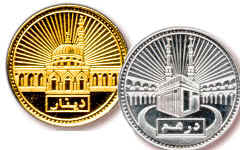
|
 |
LONDON
– Next month Malaysian Prime Minister Dr. Mahathir Muhammad will address an
international seminar on the adoption of the Islamic dinar as the unit of
currency for international trade, especially between the Muslim countries.
The two-day seminar, scheduled to be held on June 25-26 in Kuala Lumpur under
the patronage of the Institute of Islamic Thought, a Malaysian think tank, hopes
to bring together a cornucopia of central bank officials, economists, bankers,
businessmen, academics and other interested parties.
Dr. Mahathir, who is also the country’s finance minister, first mooted the
idea of an Islamic gold dinar as a standard unit of currency for trade and
financial transactions between the 54 member countries of the Jeddah-based
trans-national Islamic Development Bank (IDB), last year. This in the aftermath
of the currency crisis that hit the Asian countries, including Malaysia, so
badly in 1999 and in 2000.
The Malaysian premier, whose government is the most proactive supporter of
Islamic finance in the world and which has instituted a dual banking policy, a
conventional system operating side-by-side with an Islamic one, cooperating but
not interacting, has already hosted a domestic convention on the subject.
The volatility in the currency markets still persist today, and the Muslim
countries, many of whom are primary commodities producers, are perhaps amongst
those that are most affected. World commodity prices including crude oil,
natural gas, palm oil, natural rubber, rice, tea and so on, are quoted on the
commodity and futures exchanges in the US dollar.
Not surprisingly, many of the Muslim currencies including the Malaysian ringgit,
the Saudi riyal, the Kuwaiti dinar, the UAE dirham, have traditionally been
pegged to the US greenback. Malaysia was forced to go down this route in 1999,
following the Asian crisis which saw the US dollar and other international
currencies such as the Japanese yen and sterling sharply appreciate against the
ringgit. However, pegging your currency to a strong international currency such
as the US dollar has its upside and downside. When the dollar is strong, then
those currencies tracking the dollar, similarly remain strong relative to the
other international currencies.
But the greenback itself can be susceptible and has crashed against a clutch of
currencies three times in the last two decades in 1985, 1988, and according to
some analysts, is currently in the process of decline. So much so that some
bankers in London confirm that already US investors are moving into non-dollar
assets. Falling US share prices and the steady rise in the price of gold, are
two other signs that the once-mighty dollar is on the decline and confidence in
US-backed assets is on the decrease. Even the once-troubled euro last week
closed at a healthy 92 US cents, almost 10 percent up on its all-time low in
October 2000.
Some European central banks are already having to cut interest rates to stem a
rush of abandoning the US dollar into their currencies. Part of the problem is
that the US economic recovery post 9/11 is an artificially engineered one, and
one fueled largely by a flood of foreign funds — currently about $400 billion
a year, and projected to rise to a staggering $800 billion a year within four
years, if the dollar does not fall. America in a nutshell is living beyond its
means. It is spending more than it is saving, and borrowing the balance from
abroad.
Various economists over the last few decades, following the Bretton Woods
agreement after the World War II and the abandonment of the gold standard, have
hankered romantically for a return to a new gold standard or its 21st century
equivalent. Is Dr. Mahathir’s call for an Islamic gold dinar unit of currency
a mere coincidence, in this respect?
It certainly is not a new idea. Several Muslim economists and prominent Shariah
compliance experts have called for such a unit of currency in the past or some
sort of return to a gold standard.
In fact, the Islamic dinar does already exist as the unit of currency of the
Islamic Development Bank (IDB). But the IDB’s dinar is also indirectly pegged
to the US dollar, because one Islamic dinar is equivalent to one special drawing
rights (SDR) of the International Monetary Fund (IMF), which needless to say, is
quoted in the US dollar. As such the US dollar remains the de facto unit of
currency of the IDB even if its accounts and internal accounting is presented in
Islamic dinars.
How pragmatic or efficacious is Dr. Mahathir’s suggestion for the
establishment of the Islamic dinar?
Malaysia in terms of innovating payments arrangements between developing
countries, has set some notable precedents. It was Dr. Mahathir’s current
economic adviser, Tan Sri Nor Mohammed Yakcop, also the architect of
Malaysia’s Islamic banking system, who pioneered the bilateral payments
arrangement (BPA), whereby Malaysia could settle its trading accounts with
individual emerging countries such as Chile, Algeria, and Iran, through the two
respective central banks, without the involvement of costly correspondent banks
in London, New York or Frankfurt. The two countries would allocate a small group
of banks in their respective countries to handle the trade transactions which
would then be settled between the two central banks on an annual basis.
When Yakcop suggested to expand the BPA into a multilateral payments arrangement
(MPA), which was due to be discussed at the Group of 77 developing countries
summit in New Delhi in the mid-1990s, it was the mighty IMF that intervened and
warned Malaysia that any adoption of the MPA would constitute a contravention of
IMF membership rules. The Fund swiftly dispatched a delegation to Kuala Lumpur
to press home the implicit threat, and the suggestion never made it on to the
G-77 agenda.
Tan Sri Nor never could hide his disappointment over the sidelining of the MPA.
Today, he is spearheading an urgent review of Malaysia’s serious corporate
debt restructuring situation.
As to the pragmatism or efficacy of the Mahathir suggestion, it is highly
unlikely that an Islamic dinar unit of exchange between Muslim countries would
take off, at least under present circumstances. Economic disparities; lack of
capital markets formation; weak currencies; lack of economic liberalization and
reforms; lack of political consensus and unity amongst the Muslim countries;
dependence on primary commodities such as oil, gas, palm oil, rice, tea, etc.
– these are all factors that would seriously delay any successful
implementation of an Islamic dinar unit of exchange.
| |
|



![Islaam pure and clear, that is according to the Qur'ân and the authentic Sunnah the way of the Salaf [ http://www.allaahuakbar.net ]](../image/question.jpg)
